English
 Deutsch
 عربى
News
Home / News / Industry News / How Integrated Sofa Bed Mechanisms Are Evolving for Modern Furniture Manufacturing

The quality of a sofa bed is often decided by something customers rarely see: the metal mechanism underneath the cushions. It determines how the sofa opens, how much effort is needed to turn it into a bed, and whether the sleeping platform remains stable once unfolded.
A mechanism that works poorly can make even an attractive sofa frustrating to use. Stiff movement, loose connections, noisy hinges and uneven support are problems that furniture manufacturers cannot solve simply by changing the upholstery. This has led to more attention being paid to mechanism construction, linkage design and assembly precision.
Fitting a Full Sleeping Function Into a Smaller Space
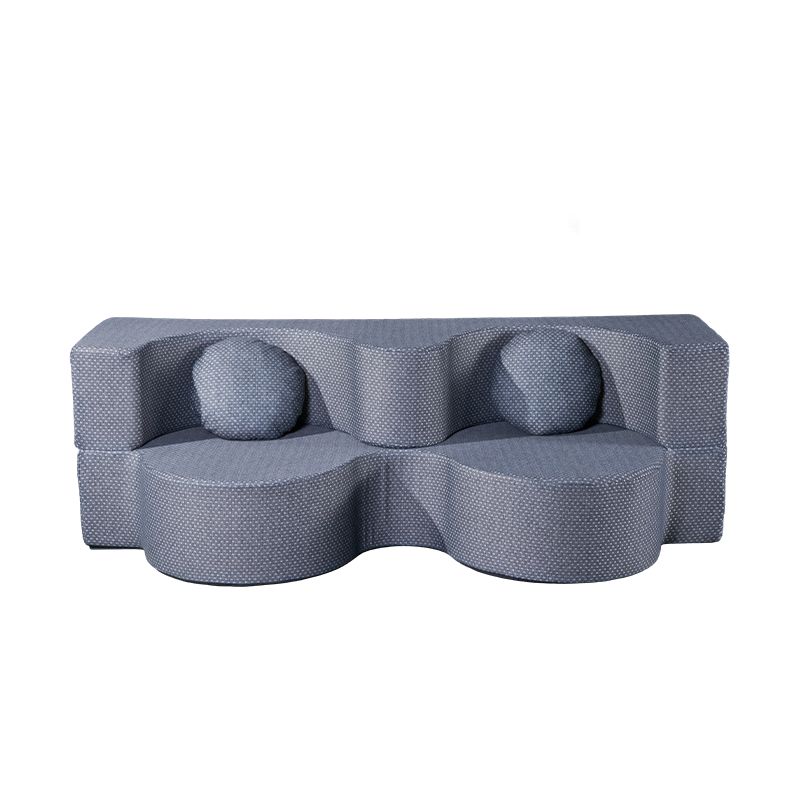
Many sofa beds are designed for apartments, guest rooms and multifunctional living spaces where floor area is limited. Customers want a proper sleeping surface, but they do not necessarily have enough room for a bulky sofa with a complicated opening system.
This puts pressure on the mechanism design. Sliding rails, pivot joints and folding support frames need to work within the available space without interfering with one another.
The position of the seat, backrest and extended platform must be considered together. A change in seat depth, for example, can affect how far the sleeping section needs to travel and where its support points should sit.
Reducing the mechanism's size is useful only when its load-bearing capacity and movement remain reliable. An overly compact structure may leave insufficient support beneath the sleeping platform.
Getting the Opening and Closing Movement Right
Anyone who has used a poorly designed sofa bed will recognize the problem: one section moves easily, another catches, and the whole structure needs to be pushed or lifted into place.
These problems often come from the linkage arrangement. Pivot positions, connecting arms and sliding components determine how the different sections move in relation to each other.
Common components include:
The mechanism needs a controlled movement sequence. Components should not collide, bind or shift unexpectedly as the sofa changes between configurations. Pinch points around accessible joints also need attention, particularly in furniture intended for family homes.
Material Choices Affect More Than Load Capacity
Steel remains widely used for sofa bed frames, brackets and linkage arms. It provides the strength needed for supporting loads and can be processed through cutting, stamping, bending and welding.
Other materials have their place too. Aluminum alloys can reduce component weight in selected applications, while engineering plastics are useful for bushings, spacers and guides where friction or noise needs to be controlled.
| Material | Typical application | Main consideration |
|---|---|---|
| High-strength steel | Support frames and linkage arms | Strength, fatigue resistance and corrosion protection |
| Aluminum alloy | Selected lightweight components | Load capacity and deformation resistance |
| Engineering plastics | Bushings, guides and spacers | Wear resistance and dimensional stability |
| Protective coatings | Exposed metal surfaces | Corrosion resistance and coating durability |
Material selection needs to account for repeated movement, fatigue and the loads generated during sitting and sleeping. A component that withstands a single heavy load may still wear prematurely after thousands of conversion cycles.
Small Manufacturing Errors Can Affect the Whole Mechanism
Integrated mechanisms contain multiple parts that must line up correctly. A misplaced pivot hole or slightly distorted bracket can change the movement path. Poor welding alignment may also cause friction or prevent locking components from engaging properly.
Different manufacturing stages require different controls:
| Production stage | Common quality issue | Inspection focus |
|---|---|---|
| Metal cutting | Incorrect dimensions | Critical measurements |
| Stamping and bending | Inconsistent shapes or angles | Forming accuracy |
| Welding | Distortion and weak joints | Weld quality and alignment |
| Surface treatment | Uneven coating | Coverage and adhesion |
| Final assembly | Misaligned components | Clearances and positioning |
| Functional testing | Irregular movement | Repeated opening and closing |
Assembly fixtures are particularly useful for keeping brackets and pivot points in consistent positions. For OEM production, dimensions such as mounting-hole locations, rail alignment and connection spacing should be clearly specified before mass production begins.
Reducing Noise Without Weakening the Structure
Metal components naturally create some noise during movement, but excessive knocking, scraping or squeaking usually points to a design or assembly issue.
Loose fasteners, poorly aligned joints and excessive clearance can all contribute. Manufacturers sometimes use bushings or spacers at pivot connections to reduce direct metal contact. Suitable lubrication may also help, depending on the mechanism's construction.
There is a limit to how much noise can be reduced through added soft materials. Components still need to withstand repeated loads, and any material placed around a joint must remain secure throughout the product's service life.
Testing should include repeated opening and closing rather than relying on the first few operations. Noise that develops after use may indicate wear or loosening that an initial inspection would miss.
Modular Construction Makes Custom Orders Easier to Manage
Furniture brands often request different seat widths, sleeping dimensions, opening directions and frame arrangements. Developing a completely new mechanism for each order can increase engineering and tooling costs.
Some manufacturers address this by using a shared mechanism platform with adaptable brackets, connecting arms or extension components.
The approach allows certain parts to be reused across several sofa models. However, changing the dimensions of one section can affect the loads and movement of others. A wider sleeping platform, for example, may require different support arrangements.
Each customized version needs its own compatibility checks. Reusing the same core mechanism does not mean every configuration will have identical performance.
Test the Mechanism Inside the Finished Sofa
A mechanism may move smoothly on a factory workbench but behave differently after installation. Upholstery thickness, frame dimensions and assembly tolerances can all affect its movement.
Testing the completed sofa bed should cover the following:
The test loads and cycle counts should reflect the product's intended use and applicable market requirements. Recording the results also makes it easier to compare different mechanism designs and identify problems during production.
What Matters in the Next Stage of Sofa Bed Development
Sofa bed mechanisms are becoming more closely tied to the overall furniture design. Their dimensions affect the finished sofa's size, their movement determines how convenient it is to use, and their construction influences long-term durability.
For OEM manufacturers, the challenge is to accommodate different furniture designs without losing control over mechanical performance. A mechanism should open without a struggle, hold the sleeping platform securely and continue doing so after repeated use. Those are the qualities customers will notice long after the sofa has left the showroom.

+86-15557615150/ +86-18767679399
+86-15558611552
No. 2430 Pengbei Avenue, Taizhou Bay Industrial Cluster Area, Taizhou City, Zhejiang Province
Copyright © Taizhou Lishida New Material Technology Co., Ltd. All Rights Reserved.
 China Compressed Sofa Factory
 Previous